
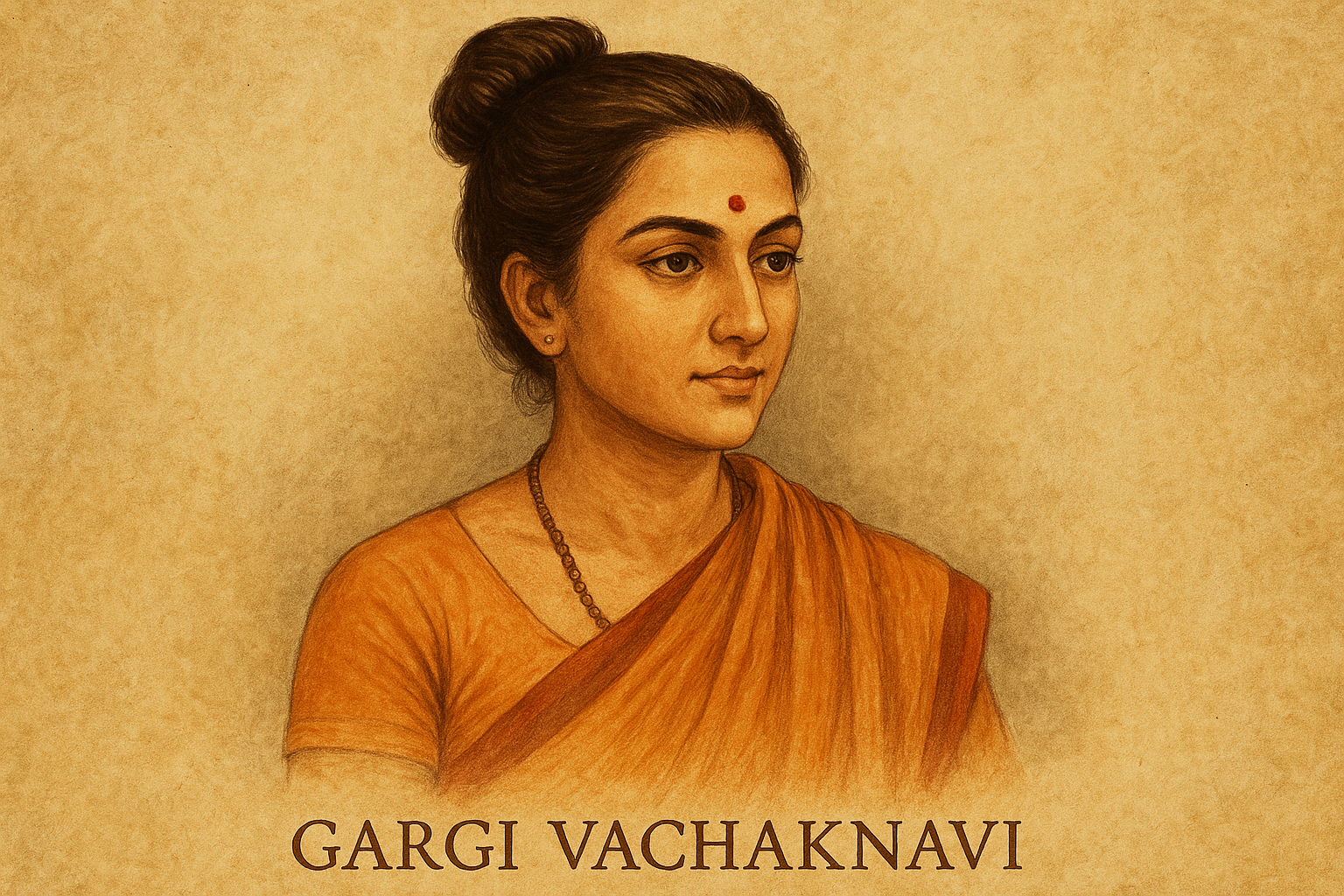
In today’s world, where gender equality is still being sought, we often forget that the roots of Sanatana Dharma nurtured a time where women were not only respected but revered as scholars, saints, and spiritual giants. Among them, one name shines with unmatched brilliance—Gargi Vachaknavi.
Her story is not just about philosophy; it is a living example of how Sanatana Dharma once empowered women to rise as equals in intellect, spirituality, and public discourse.
Who Was Gargi?
Gargi was a renowned philosopher during the Vedic period , when India’s spiritual foundation was being laid through the Vedas and Upanishads. She was not a silent observer in the world of men—she was a voice that questioned, challenged, and elevated discourse.
She is best known from the Brihadaranyaka Upanishad, where she participates in a philosophical debate with the sage Yajnavalkya, demonstrating exceptional courage, clarity, and spiritual insight.
The Great Debate: Brihadaranyaka Upanishad (3.6–3.8)
In the court of King Janaka of Videha, a grand assembly of sages had gathered to determine the greatest knower of Brahman. Among them, Gargi stood tall and challenged the revered Yajnavalkya with questions that reached the edge of metaphysical inquiry.
She asked:
“कस्मिन्न् खलु अखिले इदं ब्रह्म च प्रतिष्ठितं?”
“On what, indeed, is all this Brahman (universe) established?”
— Bṛhadāraṇyaka Upaniṣad 3.6.1
Step by step, Gargi led the dialogue deep into the heart of cosmic mystery, ultimately questioning the Imperishable (Akṣara)—the eternal reality beyond time, space, and causality.
Her inquiry was so profound that Yajnavalkya gently cautioned her:
“माऽतिसृज गर्गि, मा ते मूर्धा व्यपपतन।”
“Gargi, you are reaching into realms where the mind may falter—tread carefully.”
— Bṛhadāraṇyaka Upaniṣad 3.6.1
This was not a dismissal, but a metaphorical reminder that certain truths lie beyond the reach of logic and can only be known through inner spiritual realization. His words reflected both the depth of her questioning and the reverence he held for her rare intellect and fearless pursuit of truth.
The Role of Women in Ancient Hinduism
Contrary to modern misconceptions, ancient Hindu society celebrated women as equals in spiritual and intellectual arenas.
“यत्र नार्यस्तु पूज्यन्ते रमन्ते तत्र देवता:।”
“Where women are honored, there the gods rejoice.”
— Manusmriti 3.56
In the Vedic era, women:
- Composed hymns of the Rigveda (e.g., Apala, Ghosha, Vishwavara)
- Took part in public debates (e.g., Gargi, Maitreyi, Sulabha)
- Pursued moksha (liberation) as ascetics and seekers
- Participated in education, rituals, and scholarly discourse
Women were seen not only as nurturers of life but as upholders of dharma, wisdom, and cosmic order.
Hinduism and the Divine Feminine
Hinduism does not place the feminine as secondary—it deifies it.
“या देवी सर्वभूतेषु विद्या रूपेण संस्थिता। नमस्तस्यै नमस्तस्यै नमस्तस्यै नमो नमः॥”
“To the Goddess who resides in all beings as knowledge—we bow again and again.”
— Devi Mahatmya
From Saraswati (wisdom) to Durga (strength) and Lakshmi (abundance), the Divine Feminine (Shakti) is central to Hindu theology. This reverence was reflected in society, where women like Gargi were not anomalies—they were pillars of the spiritual ecosystem.
Why Gargi Matters Today
In a time when many seek to rediscover identity, equality, and spiritual power, Gargi’s legacy becomes more than historical—it becomes transformational.
She reminds us that:
- Hinduism, in its purest form, honors both Jñāna (knowledge) and Shakti (power)—regardless of gender.
- True dharma is about awakening the divine within, not suppressing it based on gender or role.
- Women have always had a sacred space in Hinduism—we just need to remember.
Let Us Reclaim This Truth
Let us revive the wisdom of women like Gargi, Maitreyi, Lopamudra, and Sulabha. Let us celebrate the ancient times when Hinduism was a beacon of gender balance and spiritual enlightenment.
This is not just our past—it is our heritage.
“साहसं साधयेत् स्त्रीणाम्, न केवलं सौंदर्यं शोभायते।”
“It is courage that adorns a woman, not just beauty.”
— Inspired by ancient sentiments
References:
- Brihadaranyaka Upanishad (Chapters 3.6 to 3.8) – Debate of Gargi and Yajnavalkya
- Rigveda – Hymns composed by female rishis (Rishikas)
- Manusmriti 3.56 – Honor and role of women in dharma
- Devi Mahatmya – Praise of the Divine Feminine
- Scholarly translations by Swami Madhavananda, S. Radhakrishnan, and Patrick Olivelle